Indian Women Cricket Team
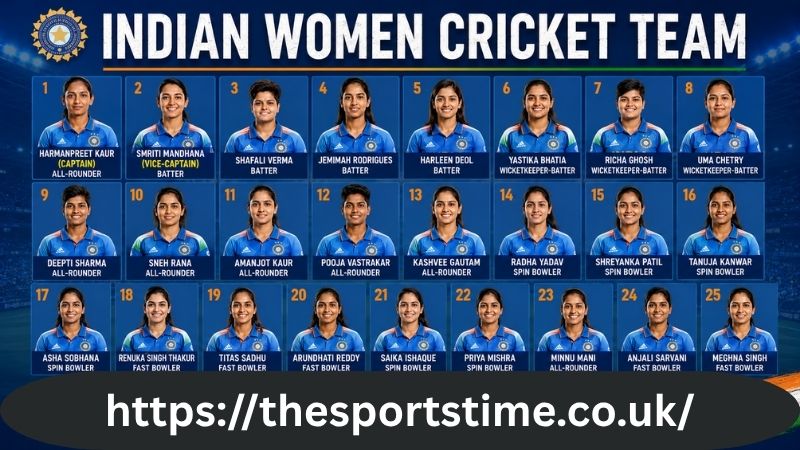
| No. | Player | Role |
|---|---|---|
| 1 | Harmanpreet Kaur (Captain) | All-Rounder |
| 2 | Smriti Mandhana (Vice-Captain) | Batter |
| 3 | Shafali Verma | Batter |
| 4 | Jemimah Rodrigues | Batter |
| 5 | Harleen Deol | Batter |
| 6 | Yastika Bhatia | Wicketkeeper-Batter |
| 7 | Richa Ghosh | Wicketkeeper-Batter |
| 8 | Uma Chetry | Wicketkeeper-Batter |
| 9 | Deepti Sharma | All-Rounder |
| 10 | Sneh Rana | All-Rounder |
| 11 | Amanjot Kaur | All-Rounder |
| 12 | Pooja Vastrakar | All-Rounder |
| 13 | Kashvee Gautam | All-Rounder |
| 14 | Radha Yadav | Spin Bowler |
| 15 | Shreyanka Patil | Spin Bowler |
| 16 | Tanuja Kanwar | Spin Bowler |
| 17 | Asha Sobhana | Spin Bowler |
| 18 | Renuka Singh Thakur | Fast Bowler |
| 19 | Titas Sadhu | Fast Bowler |
| 20 | Arundhati Reddy | Fast Bowler |
| 21 | Saika Ishaque | Spin Bowler |
| 22 | Priya Mishra | Spin Bowler |
| 23 | Minnu Mani | All-Rounder |
| 24 | Anjali Sarvani | Fast Bowler |
| 25 | Meghna Singh | Fast Bowler |
The Indian Women’s Cricket team represents India internationally. The Board of Control for Cricket in India (BCCI) governs them.
Cricket binds both urban and rural Indian communities together like no other activity can, providing an emotional outlet that unites our nation as one. Cricket defines India’s identity.
The journey
Since 1975, India’s women’s cricket team has come a long way since its humble beginnings in 1975. Since then, their story is one of transformation and determination that has transformed into stadium-filling performances, inspiring millions of young girls who believe their dreams can come true with bat in hand. A win for everyone in India; an example of spirit and resilience that will live on forever!
At first, cricket was considered a men-only sport. When the inaugural Women’s Premier League (WPL) match began in 2018, a new era of women’s cricket emerged – fast, thrilling and glamorous like no other before it. This global platform allowed women’s cricketers to establish themselves alongside millions of new fans while opening doors for corporate investments and international exposure; making women’s cricket an international sport!
WPL helped India’s women’s cricket team emerge as an undisputed power, sending out an inspiring message of unity and hope through its victory at the World Cup. More than just sporting achievement, India’s victory also marked an indelible cultural moment that catapulted India to unimaginable heights; beyond being just another symbol of success it stands as testament to human spirit powering true equality for all.
India’s women’s cricket team has an exciting future ahead. Everyone eagerly anticipates seeing them play again.
The Board of Control for Cricket in India (BCCI) is the governing body for men’s and women’s cricket in India, serving as a full member of the International Cricket Council with Test, One Day International, Twenty20 International status. As part of its duties it sells media rights; arranges matches through Future Tours program; manages national team sponsorship and selection processes and sells media rights; sells media rights; determines future matches via Future Tours program and manages sponsorship deals on behalf of national team; sells media rights sales media rights sales are managed for media rights sales alone making this organization one of most successful and influential sports organizations worldwide ranked by Forbes as fifth most valuable franchise ranked by 2025! Led by former Indian cricketer Amita Sharma who became chief selector for any major international team team during her reign at its helm
The victory
After an emotionally trying year during which they were written off by many, India’s women in blue made history when they won the World Cup for India for the very first time. Their victory represented not just those 15 players adorned in blue jersey, but all those homes, hearts, and dreams who dared believe. From young girls playing gully cricket matches in their neighborhoods to proud grandmothers watching on, this victory belonged to all.
Harmanpreet Kaur and her team won an incredible victory, defeating both Australia in the semifinals and four-time winner England in the final – becoming the youngest nation ever to claim world championship glory and ending Australia and England’s run at all previous championships.
At an emotional yet fittingly joyful moment in an innings and 57 balls, South African captain Annerie Dercksen edged towards wicketkeeper Amanjot Kaur and set off the celebrations as India claimed their maiden World Cup title by 52 runs.
Indian bowlers were key to India’s victory, particularly Mithunaratne Narayan (three wickets, Deepti Sharma two) and Shafali Verma (87 runs off 78 balls, helping India achieve 298-7 after losing the toss).
India then pulled off an unexpected ending when they bowled out South Africa for 246 in only 45.3 overs, after Verma had helped set the target with her batting, sharing an opening stand of 104 runs with Smriti Mandhana. But once again, India’s bowlers proved too strong for South African chasers with Sharma taking key wickets of Dercksen and Wolvaardt while Amanjot Kaur took an amazing diving catch from deep midwicket to dismiss Wolvaardt; thus ending India’s dream era – an end that began back in 1983 when Kapil Dev transformed Indian cricket forever.
The future
After years of narrowly missing their mark, India’s women in blue are finally in control of their destiny and poised for another World Cup success – but can they keep up their momentum and secure back-to-back triumphs?
The Indian national cricket team is overseen by the Board of Control for Cricket in India (BCCI), which is an integral member of the International Cricket Council with Test, One Day International and Twenty20 International status. Furthermore, BCCI stands as one of the world’s most successful sports organizations by selling media rights for matches to over one hundred broadcasters worldwide.
India have been guided by several coaches over time, including Ravi Shastri, Rahul Dravid and Amol Dhoni. Ramesh Powar – who played Test fast bowling himself – currently coaches.
Although India are considered one of the premier women’s cricket teams, they have come under scrutiny for how they treat female players and are reluctant to change rules for them. Under pressure to address issues of pay equality and grow women’s cricket games.
The BCCI recently announced that from 2022 onwards it will offer equal match fees to men and women cricketers, marking an encouraging step for women’s cricketers. Although the move will benefit women’s cricket overall, its impact must be felt more broadly across India’s cricket board and team players; additionally the Indian Women’s team needs to play more Test matches so the long format becomes an option; currently their Future Tours Programme cycle offers only three Test matches out of the four sides competing in it; to improve this situation the Indian Cricket board should seek sponsorships or government support to make this possible.
The legacy
Team India women have expanded cricket beyond sport into society. They have inspired millions of girls who now dream of becoming cricket players themselves and stadiums once full of men are now filled with supporters cheering on these “Women in Blue”, showing that cricket can bring equality among its people and not only be played by men.
Jemimah Rodrigues’ spectacular century, Deepti Sharma’s crucial wickets and Amanjot’s game-altering catches were all breathtaking World Cup performances that brought joyous cheer. Every match offered memorable moments that highlighted both their individual brilliance and team harmony.
India Women’s Team have become a symbol of perseverance and determination. They have heralded an era of research-driven progress where ambition and inclusivity are changing the game; their legacy will only continue to expand as they push boundaries and inspire.
Women have taken over, redefining cricket like never before. Social media has provided the world’s new arena, blurring boundaries between men’s and women’s cricket and showing open admiration for its passion and talent. Millions have shown open admiration for India’s Women in Blue; millions from working professionals to young students alike have shown open appreciation of them with global coaching, better facilities and an ever-expanding fan base showing open appreciation of them as never before! With global coaching available and global facilities improving rapidly – just think – maybe one day soon they might actually dominate world cricket like we never thought possible before seeing screams of joy be even louder from across India! India stands tall!
Related Post
England Cricket Team Vs India National Cricket Team Timeline
The england cricket team vs india national cricket team timeline reflects a rivalry that is [...]
Jacksonville Jaguars Vs Las Vegas Raiders Match Player Stats
DaVon Hamilton used his hands to deflect Geno Smith’s two-point conversion attempt into the ground [...]