Indian Cricket Team
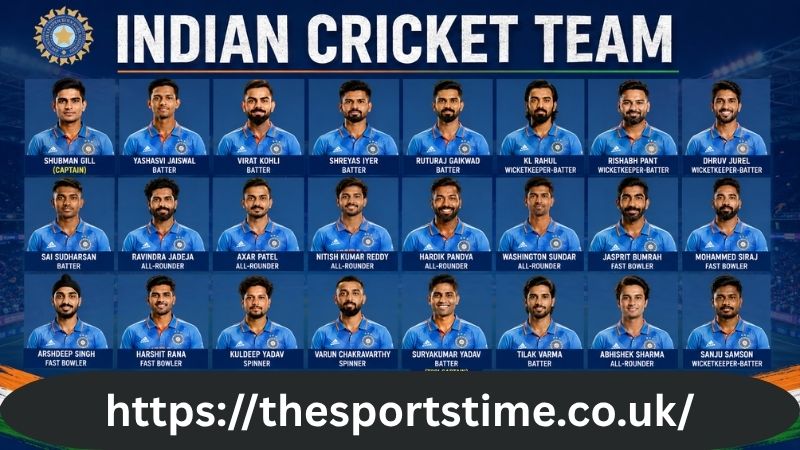
| No. | Player | Role |
|---|---|---|
| 1 | Shubman Gill (Captain) | Batter |
| 2 | Yashasvi Jaiswal | Batter |
| 3 | Virat Kohli | Batter |
| 4 | Shreyas Iyer | Batter |
| 5 | Ruturaj Gaikwad | Batter |
| 6 | KL Rahul | Wicketkeeper-Batter |
| 7 | Rishabh Pant | Wicketkeeper-Batter |
| 8 | Dhruv Jurel | Wicketkeeper-Batter |
| 9 | Sai Sudharsan | Batter |
| 10 | Ravindra Jadeja | All-Rounder |
| 11 | Axar Patel | All-Rounder |
| 12 | Nitish Kumar Reddy | All-Rounder |
| 13 | Hardik Pandya | All-Rounder |
| 14 | Washington Sundar | All-Rounder |
| 15 | Jasprit Bumrah | Fast Bowler |
| 16 | Mohammed Siraj | Fast Bowler |
| 17 | Arshdeep Singh | Fast Bowler |
| 18 | Harshit Rana | Fast Bowler |
| 19 | Kuldeep Yadav | Spinner |
| 20 | Varun Chakravarthy | Spinner |
| 21 | Suryakumar Yadav | Batter (T20I Captain) |
| 22 | Tilak Varma | Batter |
| 23 | Abhishek Sharma | All-Rounder |
| 24 | Sanju Samson | Wicketkeeper-Batter |
| 25 | Rinku Singh | Batter |
Early 20th-century Indian cricket took on multiple cultural and political nuances for Parsis communities. Cricket embodied new relationships with colonial society while helping alleviate their anxieties about community decline.
International highlights during this era included a sensational first ODI World Cup win in 1983 and the rise of legendary batsmen such as Sachin Tendulkar, VVS Laxman and later Virender Sehwag.
Origins
Indian cricket team is one of the powerhouses of world cricket, boasting an enormous fan base worldwide. Additionally, this multiracial squad contains many diverse races, religions, and social classes who all play for them – dating back to early 20th Century India where cricket took on various cultural and political significances.
After an uneven beginning in the late 1990s, India finally found their feet under Sachin Tendulkar’s tutelage in the late ’00s and during this period they proved themselves extremely dominant domestically; particularly against Australia – something Steve Waugh dubbed them as the “final frontier.” Furthermore they won several tests abroad such as Zimbabwe, Sri Lanka, West Indies, and England.
At the turn of the 21st Century, India maintained their upward trajectory. Led by Rahul Dravid and then Mahendra Singh Dhoni as captains, India became one of the dominant sides in limited-overs cricket – winning three ICC Champions Trophies, two ODI World Cups, and two Asia Cups respectively.
Even after experiencing success, India struggled to replicate their dominance overseas in Test matches outside the subcontinent. Their performances began to improve after Sourav Ganguly became captain and fast bowlers such as Irfan Pathan and Munaf Patel were included on the team; additionally Rahul Dravid and Virender Sehwag began contributing more often as batsmen.
Rules
Indian cricket was formed in 1911, and played its inaugural Test match against England at Lord’s in 1932, winning it decisively and giving rise to today’s formidable national cricket team that boasts both an enormous fan base and highly talented players.
In the 1990s, India experienced unprecedented success in Test cricket at home and internationally. Sachin Tendulkar became a world-record-setting superstar batter like no other before him; alongside Rahul Dravid, VVS Laxman, Virender Sehwag and Javagal Srinath’s bowling prowess; all this led to India becoming an outstanding Test side overall during this era.
India was one of the top teams in ODI cricket for several decades and won three Asia Cup championships between 1988 and 1995, taking home titles in 1988, 1991, and 1995. Although their performance at the 1992 Cricket World Cup wasn’t too impressive, they managed to retain an unbeaten home record against Australia for over 10 years, prompting Steve Waugh to describe India as “the last frontier”.
India have also achieved much in T20I cricket, winning numerous trophies under MS Dhoni’s captaincy including winning the inaugural World T20 Championship and going on to claim three consecutive championships since 2013.
India A cricket team is a development squad of the Indian men’s national cricket team, receiving both first-class and List A classification for its matches. Comprised largely of domestic players on their way towards making the main squad, some international players who don’t quite fit fit also occasionally play for India A.
Matches
India are unrivalled Test cricket powerhouses, having won all but four full home series since 1987. India are led by world-class spinners Ravichandran Ashwin and Anil Kumble and fast bowlers like Jasprit Bumrah and Mohammed Shami – along with legendary batsmen Sachin Tendulkar, Rahul Dravid, and Sourav Ganguly who have achieved great success bringing success for them as batsmen.
India have shown they can compete effectively at both home and away grounds in shorter forms of cricket, such as T20 World Cups (2007, 2015 and 2021 T20), reaching the final in each and beating arch-rival Pakistan before going down against England in a thrilling contest in 2021 T20 World Cup. Dhoni led their efforts for most of these shorter tournaments until recently when Kohli took charge.
The Indian Cricket Board (BCCI) is the governing body for cricket in India and represents it before the International Cricket Council. As one of the richest sports organizations, selling global media rights valued at $612 Million between 2006 and 2010, its headquarters can be found in Mumbai with Mithun Manhas serving as President.
The India A cricket team is a developmental side that plays second-tier cricket. Comprised mainly of domestic players, but sometimes featuring international stars who do not make India’s national squad roster. Led by Ramesh Pokhari as coach and Rishant Sharma as captain, this squad has won twice at the ICC Emerging Teams Asia Cup tournaments since 2014.
Players
The Indian Cricket Team is a professional sports team selected by the Board of Control for Cricket in India (BCCI). Members receive annual player contracts as well as match fees of Rs15 lakh (US$16,000) per Test match, Rs6 lakh (US$6,300) per ODI match, and Rs3 lakh (US$3,100) per T20I game played – in addition to receiving bonuses upon victory from BCCI.
India has become one of the premier teams across all forms of cricket since 1987. They have traditionally excelled at home and won an impressive amount of full test series. World-renowned fast bowlers Mohammad Shami and Jasprit Bumrah standout among others on the side. Furthermore, India are well known for their batsmen; several batsmen currently rank within their top five batsmen rankings.
India have enjoyed great success in shorter formats of cricket as well, including winning the inaugural ICC World Twenty20 tournament back in 2007, reaching two out of the four final rounds, as well as taking home multiple other trophies in this format.
India’s success in modern white-ball cricket can be traced to an exceptional captain. Rahul Dravid led from 2000 until his retirement in 2004, followed by Sourav Ganguly who led India to their second world cup and an Indian victory against South Africa at home series level in 1996. Tendulkar replaced Ganguly late that same year but soon lost form and was later replaced by Sachin Tendulkar; both played pivotal roles in their team’s rise during the 1990s alongside Anil Kumble and Rahul Dravid being key members; Tendulkar remains India’s highest run scorer and most prolific home captain.
Coaches
Indian cricket team is among the world’s most revered, boasting outstanding talent, thrilling performances, and historic wins. Behind every win lies an influential coach who strategizes against opponents while shaping team identity – both domestic stars as well as international experts have been appointed by Indian Cricket Board since 1971! Let’s look back over this incredible journey from 1971-2025 of India cricket’s coaches!
India’s early coaches were former players themselves. Hemu Adhikari was one of these coaches; he advocated discipline and teamwork – concepts new to Indian cricket at that time – while spinner Bishan Singh Bedi played with more experimental styles, like his focus on strengthening bowling performance for India’s team. Numerous coaches were credited with nurturing young talent.
In 1992, Ajit Wadekar became India’s inaugural full-time national team coach. Under his tutelage, India enjoyed an exceptional home period during the early 1990s – including a 3-0 Test series whitewash against England – before retiring in 1996 and experiencing significant performance decline.
John Wright and Gary Kirsten were also influential coaches. Wright was the first foreign coach to bring professionalism into Indian cricket; Chappell, on the other hand, was known for clashes with players. Kirsten, on the other hand, allowed for more patience within his team’s identity to develop over time.
Gautam Gambhir is currently coaching the Indian cricket team and has helped it to achieve new levels of dominance in T20Is. Furthermore, he is known for his focus on youth development and his unflappable nature; these traits bode well as he leads them into a new era of fearless cricket that fans are looking forward to witnessing first hand.
Related Post
Chennai Super Kings Vs Rajasthan Royals Match Scorecard
CSK, with an experienced side, will aim to gain the edge against RR’s young squad, [...]
India National Cricket Team vs New Zealand National Cricket Team Timeline
New Zealand have been a great team to watch throughout this tournament. They have been [...]